


June 26, 2026
Investment Casting vs Sand Casting vs Shell Moulding: Choosing the Right Casting Process

Selecting the right casting process is one of the most important manufacturing decisions in a metal component manufacturing program. The chosen process affects geometry, dimensional accuracy, surface finish, tooling costs, machining requirements, material suitability, lead time, repeatability, and long-term production stability.
Investment casting, sand casting, and shell moulding are all established metal casting processes. Each has its own strengths. Each serves a different type of component requirement. None of them is universally better in every situation.
The right choice depends on what the component needs to achieve.
A large, simple, low-volume part may not need the precision of investment casting. A medium-volume component may benefit from the improved finish and accuracy of shell moulding. A complex component with fine detail, thin walls, tight tolerances, and reduced machining requirements may be better suited to investment casting.
Understanding the difference between these processes helps engineers, sourcing teams, and manufacturers make better early-stage decisions.
Why Process Selection Matters
Metal Casting is not just a method of producing a shape. It is a manufacturing route that influences every subsequent stage.
The casting process affects:
- Part geometry
- Wall thickness
- Surface finish
- Dimensional accuracy
- Tooling cost
- Machining allowance
- Material usage
- Repeatability
- Production scalability
- Inspection requirements
- Final component readiness
If the process is selected only on initial cost, problems may appear later in machining, inspection, assembly, or field performance.
For example, a component produced through a lower-cost process may require heavy machining, additional finishing, or more inspection to reach the required condition. Another component may cost more to cast initially but reduce downstream operations, simplify assembly, and improve consistency across production batches.
This is why process selection should be based on total manufacturing logic, not only the casting quotation.
What Is Investment Casting?
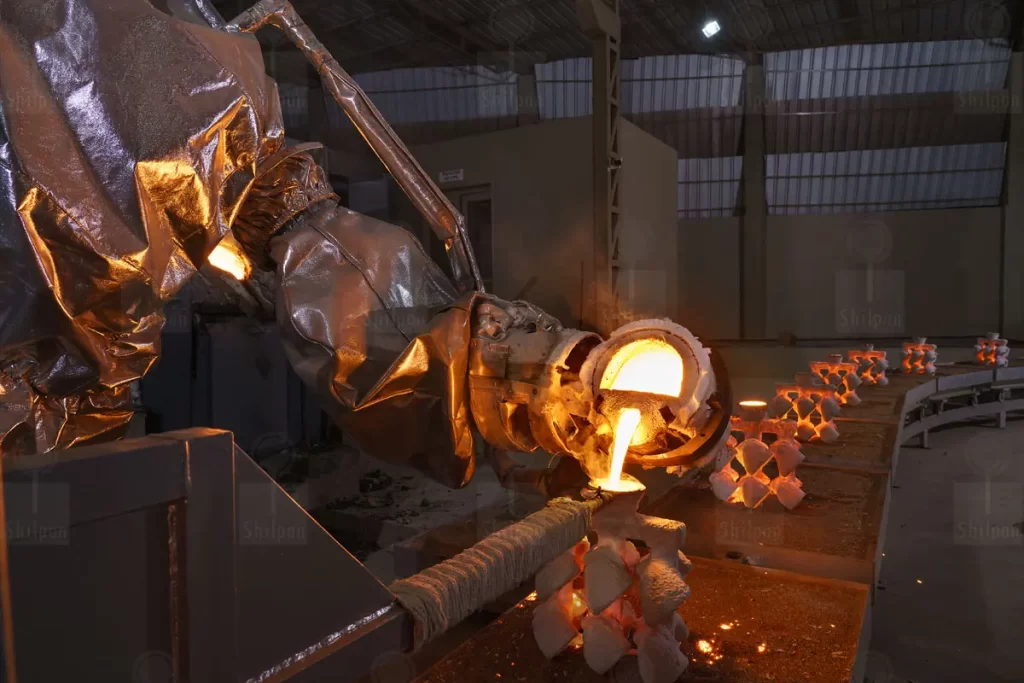
Investment casting, also known as lost-wax casting or Feinguss in German, is a precision casting process used to produce complex metal components with fine detail, accurate geometry, and good surface finish.
The process begins with a wax pattern that replicates the geometry of the final component. This pattern is coated with ceramic material to create a shell. Once the shell is formed, the wax is removed, molten metal is poured into the cavity, and the casting is produced.
Investment casting is especially useful when components require:
- Complex shapes
- Thin walls
- Intricate features
- Near-net-shape geometry
- Fine surface finish
- Tight dimensional control
- Reduced machining
- Multiple features integrated into one component
Because the wax pattern can reproduce fine detail, investment casting allows engineers to create components that may be difficult, expensive, or inefficient to produce through other casting methods.
This process is widely used for components in pumps, valves, automotive systems, aerospace applications, industrial machinery, power equipment, medical devices, and general engineering.
What Is Sand Casting?
Sand casting is one of the oldest and most widely used casting processes.
In sand casting, a pattern is used to create a cavity inside a sand mould. Molten metal is poured into the mould, allowed to solidify, and then the sand mould is broken away to remove the casting.
Sand casting is generally suitable for:
- Large components
- Simple to moderately complex shapes
- Low to medium production volumes
- Components where very fine detail is not critical
- Applications where the tooling cost must be controlled
- Parts where additional machining is acceptable
One of the biggest advantages of sand casting is flexibility. It can produce parts in a wide range of sizes and materials, including very large castings that may not be practical through investment casting or shell moulding.
However, sand casting usually produces a rougher surface finish and lower dimensional accuracy compared to investment casting. It also typically requires more machining allowance and finishing when tight tolerances or refined surfaces are needed.
For large industrial components, this trade-off can be acceptable. For smaller, complex, precision components, it may not be ideal.
What Is Shell Moulding?
Shell moulding is a casting process that uses a resin-coated sand mould. The sand is heated against a metal pattern, forming a thin, rigid shell that becomes the mould cavity.
Compared with conventional sand casting, shell moulding generally offers better dimensional accuracy, improved surface finish, and better repeatability. It is often used for medium-sized components where the required finish and accuracy exceed what sand casting can easily provide, but full investment-casting precision may not be necessary.
Shell moulding is commonly suitable for:
- Medium-volume production
- Small to medium-sized castings
- Components requiring better finish than sand casting
- Parts needing improved repeatability
- Components with moderate complexity
- Applications where tooling investment is justified
Shell moulding sits between sand casting and investment casting in many process-selection decisions. It can offer a good balance of cost, accuracy, and productivity for suitable parts.
However, it may still have limitations when components require very intricate features, thin walls, complex internal details, or very fine surface requirements. In those cases, investment casting often provides greater design freedom and precision.
Comparing the Three Processes
A useful way to compare investment casting, sand casting, and shell moulding is to look at the component requirement first.
1. Component Complexity
Investment casting is usually the strongest choice when the component geometry is complex.
It can produce intricate shapes, internal details, thin walls, undercuts, and integrated features with a high degree of accuracy. This makes it suitable for components where design complexity would otherwise require multiple parts, welding, or extensive machining.
Sand casting is more suitable for simpler or larger shapes. It can handle complex forms to some extent, but fine detail and thin features are more difficult to control.
Shell moulding offers better detail than sand casting, but it does not usually match the design freedom and fine-feature capability of investment casting.
For high-complexity components, investment casting is often the preferred process.
2. Dimensional Accuracy
Dimensional accuracy determines how close the casting is to the required final geometry.
Investment casting provides strong dimensional control because the wax pattern and ceramic shell can reproduce fine details with precision. This reduces the amount of correction needed later.
Sand casting usually requires larger tolerances and more machining allowance because the sand mould process is less precise.
Shell moulding offers better dimensional accuracy than conventional sand casting because the resin-coated shell is more stable and controlled. However, for high-precision components with multiple functional surfaces, investment casting usually provides better control.
If the final component requires tight alignment, critical interfaces, or reduced machining, investment casting becomes a strong choice.
3. Surface Finish
Surface finish affects appearance, flow characteristics, sealing, cleanliness, and the amount of finishing required after casting.
Investment casting is known for producing a finer as-cast surface finish than many other casting processes. This is one reason it is widely used for valve bodies, pump components, impellers, brackets, medical components, food equipment parts, and precision industrial hardware.
Sand casting generally produces a rougher surface because the mould surface is made from sand. Additional machining, grinding, blasting, or finishing may be needed where surface quality matters.
Shell moulding provides a better surface finish than conventional sand casting because of the smoother resin-coated mould surface. For many components, this may be sufficient.
Where surface finish is critical and machining should be minimized, investment casting often has the advantage.
4. Wall Thickness and Fine Features
Thin walls and delicate features are difficult to produce consistently in many casting processes.
Investment casting performs well in this area because the ceramic shell process can support fine details and thinner sections. This allows engineers to design components that are lighter, more compact, and closer to final shape.
Sand casting is less suitable for very thin sections because the moulding method and metal flow limitations make fine features harder to control.
Shell moulding can produce thinner sections than traditional sand casting in many cases, but investment casting remains stronger for highly detailed, fine-featured components.
For applications where weight, compactness, or geometry optimization matters, investment casting is usually more suitable.
5. Machining Requirement

Machining is often required after casting, especially for critical surfaces, threads, bores, sealing faces, and assembly interfaces.
However, the amount of machining required can vary significantly based on the casting process.
Investment casting can reduce machining because the component is produced closer to its final geometry. Critical features may still require CNC machining, but less material often needs to be removed.
Sand cast components generally require greater machining allowances, especially when dimensional accuracy and surface finish are important.
Shell moulded components may require less machining than sand castings but more than investment castings in many precision applications.
The right question is not simply, “Which process produces the lowest casting cost?”
The better question is, “Which process reduces total manufacturing effort from casting to finished component?”
6. Tooling Cost and Production Volume
Tooling cost is another important factor.
Sand casting usually has lower tooling cost, especially for simpler patterns and lower-volume production. This makes it attractive for prototypes, large components, or limited production runs where fine precision is not essential.
Shell moulding requires more specialized tooling than sand casting, but it can provide better repeatability and productivity for suitable volumes.
Investment casting tooling can require higher upfront investment, particularly for complex wax pattern dies. However, when the component is complex and produced repeatedly, the value comes from improved consistency, reduced machining, better surface finish, and stronger repeatability.
For low-volume large parts, sand casting may be more economical. For medium-volume parts with moderate accuracy needs, shell moulding may be suitable. For complex precision components with long-term production requirements, investment casting can offer a better total manufacturing route.
7. Repeatability and Production Stability
Repeatability matters when the same component must be produced consistently across batches.
Investment casting supports strong repeatability when tooling, wax pattern production, shell building, melting, heat treatment, and inspection are controlled properly. This makes it suitable for long-term programs where dimensional stability and quality consistency matter.
Sand casting can be repeatable for suitable applications, but process variation is generally higher because of mould preparation and sand-related variables.
Shell moulding improves repeatability compared with conventional sand casting because the shell mould process is more controlled.
For precision programs where repeatability affects machining, assembly, or final product reliability, investment casting often provides better long-term control.
When Sand Casting Makes Sense
Sand casting remains useful for many types of components.
It may be the right choice when:
- The part is large
- Geometry is relatively simple
- Surface finish is not critical
- Dimensional tolerances are moderate
- Production volume is low
- Tooling budget is limited
- Additional machining is acceptable
- The component does not require fine details or thin walls
Examples may include heavy industrial housings, large machine bases, pump casings, structural castings, and other components where size and cost flexibility are more important than fine precision.
Sand casting is not inferior. It is simply designed for a different manufacturing need.
When Shell Moulding Makes Sense
Shell moulding is useful when better surface finish and accuracy are needed compared with sand casting, but the component does not require the full precision or design freedom of investment casting.
It may be suitable when:
- The component is small to medium in size
- Production volume justifies tooling
- Better finish than sand casting is required
- Repeatability matters
- Geometry is moderately complex
- Tolerances are tighter than sand casting can easily support
- The part design fits shell moulding limitations
Shell moulding can be an efficient choice for certain automotive, industrial, and mechanical components where accuracy, speed, and repeatability need to be balanced.
It is often a practical middle ground.
When Investment Casting Is the Better Choice
Investment casting becomes the better choice when the component requires a higher level of precision, complexity, or application readiness.
It is especially suitable when:
- Geometry is complex
- Thin walls are required
- Surface finish matters
- Machining needs to be reduced
- Multiple features can be integrated into one part
- Tight dimensional control is required
- The component includes functional interfaces
- Long-term repeatability is important
- Assembly fitment depends on casting accuracy
- Material performance and surface quality both matter
For components where geometry, wall thickness, machining allowance, and functional interfaces must be considered early, properly designing components for investment casting becomes an important part of selecting the right manufacturing route.
Investment casting is also valuable when a component needs to move efficiently into precision machining, surface finishing, inspection, or assembly.
In this sense, investment casting is not only a casting process. It can become the foundation for a complete manufacturing route.
Process Selection Should Consider the Finished Component
A common mistake in process selection is evaluating only the raw casting.
In many programs, the casting is not the final product. It must be machined, treated, finished, inspected, assembled, packed, documented, and delivered.
The appropriate casting process should therefore be selected based on the requirements of the finished component.
A cheaper raw casting may become more expensive if it requires extensive machining, additional inspection, additional finishing, or repeated corrections. A more precise casting process may reduce downstream cost and improve production stability.
This is particularly important for components that require:
- CNC-machined features
- Sealing surfaces
- Assembly interfaces
- Tight positional accuracy
- Consistent batch production
- Application-ready delivery
When the finished component is considered, investment casting often becomes the preferred route for complex, precision parts.
How Investment Casting Supports Ready-to-Use Component Programs
Modern customers increasingly need more than raw castings. They need components that are ready for the next stage of production.
Investment casting supports this requirement because it can produce near-net-shape components that move efficiently into precision machining, surface treatments, inspection, and assembly.
When combined with downstream capabilities, investment casting can help reduce:
- Part complexity
- Machining load
- Supplier coordination
- Variation across stages
- Assembly challenges
- Production delays
- Quality risk
For manufacturers supplying ready-to-use components, the casting process must support the full manufacturing path, not just the initial shape.
This is where investment casting offers a strong advantage for complex components.
Shilpan Steelcast’s Approach to Casting Process Selection

Shilpan Steelcast’s core manufacturing focus is investment casting, supported by precision machining, assembly, strategic sourcing, and supply chain management.
As one of India’s largest investment casting manufacturers, Shilpan Steelcast supports customers who need complex cast components that can be delivered in finished, application-ready form through controlled downstream processes.
While different casting and manufacturing routes have their place, Shilpan’s value is strongest where investment casting provides the foundation for precision, repeatability, reduced machining, and ready-to-use component manufacturing.
For programs that require sourced components or alternative manufacturing inputs, Shilpan’s strategic sourcing and supply chain capabilities help customers manage broader component requirements under a single coordinated quality system and schedule.
This supports the company’s current positioning as a single-source partner for customers who need more than standalone castings.
Conclusion
Investment casting, sand casting, and shell moulding each serve a different purpose in metal component manufacturing.
Sand casting is often suitable for large, simpler, or lower-volume components where flexibility and lower tooling cost matter. Shell moulding offers improved surface finish and repeatability for suitable medium-sized components. Investment casting provides the strongest advantage when complexity, surface finish, dimensional accuracy, thin walls, reduced machining, and ready-to-use component flow are important.
The right process depends on the component’s geometry, tolerance needs, production volume, material, surface finish, and downstream manufacturing requirements.
For complex precision components, investment casting often provides the most efficient path from design to finished part.
When selected correctly, the casting process does more than shape metal. It shapes the reliability, cost, and performance of the entire manufacturing program.
Choose the Right Route for Precision Metal Components
If your component requires complex geometry, controlled accuracy, reduced machining, and a clear path toward finished or ready-to-use delivery, investment casting may offer the right manufacturing foundation.
Shilpan Steelcast supports investment casting programs through integrated precision machining, assembly, strategic sourcing, and supply chain management within a single coordinated manufacturing system.
Latest Post
-
 September 3, 2026 Non-Destructive Testing for Investment Cast Components: A Practical Guide
 -
August 28, 2026 Gating and Feeding in Investment Casting: Why Metal Flow Determines Casting Quality
-
July 31, 2026 Strategic Sourcing in Ready-to-Use Component Programs: Why Control Matters Beyond the Casting