



October 31, 2026
Near-Net-Shape Investment Casting: Reducing Machining, Material Waste and Component Complexity

One of the most important advantages of investment casting, or lost-wax casting, is its ability to produce complex metal components close to their final required geometry.
This near-net-shape capability can reduce the amount of material that must be removed during machining, simplify downstream operations, improve material utilisation, and allow features to be incorporated directly into the casting that might otherwise require multiple manufacturing steps.
For engineers and sourcing teams, however, the value of near-net-shape manufacturing depends on more than simply choosing investment casting as the production process.
It requires careful decisions around component geometry, tolerances, machining allowances, datum strategy, material behaviour, surface requirements, and final functional dimensions.
When these factors are considered early, investment casting can do more of the manufacturing work before the component ever reaches a CNC machine.
What Does Near-Net-Shape Mean in Investment Casting?
A near-net-shape component is produced as close as practical to its final functional geometry while still allowing for the manufacturing tolerances, finishing operations, and critical dimensions required by the application.
The objective is not necessarily to eliminate machining completely.
Many investment cast components still require machining on:
- sealing surfaces,
- bearing locations,
- threads,
- precision bores,
- mating faces,
- mounting features,
- critical datums,
- or dimensions with very tight tolerances.
The difference is that the casting is designed so machining is applied only where it adds functional value.
Instead of starting with a large block of material and removing significant amounts through machining, investment casting can establish much of the final geometry during the casting process itself.
Why Near-Net-Shape Manufacturing Matters
Every additional manufacturing operation adds something to the production chain.
It may add:
- machining time,
- tooling requirements,
- fixtures,
- handling,
- inspection steps,
- work-in-process inventory,
- lead time,
- material loss,
- or another opportunity for dimensional variation.
Near-net-shape manufacturing aims to reduce unnecessary secondary work by placing more of the component geometry into the casting design.
For suitable parts, this can help create a simpler manufacturing route from raw material to finished component.
The benefit becomes particularly important when production volumes increase, because even a small reduction in machining time or material removal per component can become significant across thousands of parts.
Reducing Machining Without Compromising Function
Machining is often essential for critical component features.
The goal of near-net-shape casting is therefore not “no machining.”
It is the right amount of machining in the right places.
Consider a component with several external contours, ribs, bosses, mounting features, internal passages, and one critical precision bore.
Investment casting may be able to produce most of those features directly.
The machining process can then concentrate on the bore and any associated datum surfaces rather than creating the complete geometry from solid material.
This approach allows machining resources to focus on dimensions that genuinely require CNC-level accuracy.
It can also reduce:
- cutting time,
- tool wear,
- fixture complexity,
- chip generation,
- and overall cycle time.
The result is a more efficient relationship between casting and machining.
Machining Allowance Should Be Engineered, Not Added Generously
One of the most important decisions in a cast-and-machined component is the amount of material intentionally left for machining.
Too little machining allowance creates risk.
Natural casting variation may leave insufficient stock to achieve the final machined dimension.
Too much allowance creates a different problem.
Excess material increases machining time, tool engagement, material removal, and potentially distortion or process cost.
The correct allowance depends on factors such as:
- component size,
- casting geometry,
- alloy,
- feature location,
- expected casting variation,
- machining datum,
- surface condition,
- and final tolerance.
This is why machining requirements should ideally be considered during casting development rather than after the casting design has already been frozen.
A casting designed with realistic machining allowances can provide enough stock for reliable finishing without unnecessarily increasing downstream work.
Datum Strategy Connects Casting Accuracy with Machining Accuracy
Near-net-shape manufacturing becomes especially effective when casting and machining teams agree on how the component will be located and referenced.
Machining depends on datums.
If the casting does not provide stable and repeatable locating features, the machining operation may require:
- complex fixtures,
- additional setup operations,
- manual alignment,
- excessive stock,
- or corrective machining.
A better approach is to consider machining datums during component and tooling development.
This can allow the casting to include suitable locating features or reference surfaces that make downstream positioning more repeatable.
Where automated probing and workpiece alignment are used during CNC machining, a well-planned datum strategy can further help the machining system understand the actual position of the casting before material removal begins.
This connection between casting design and machining setup is one of the less visible advantages of integrated manufacturing.
Complex Geometry Is Where Investment Casting Adds Significant Value
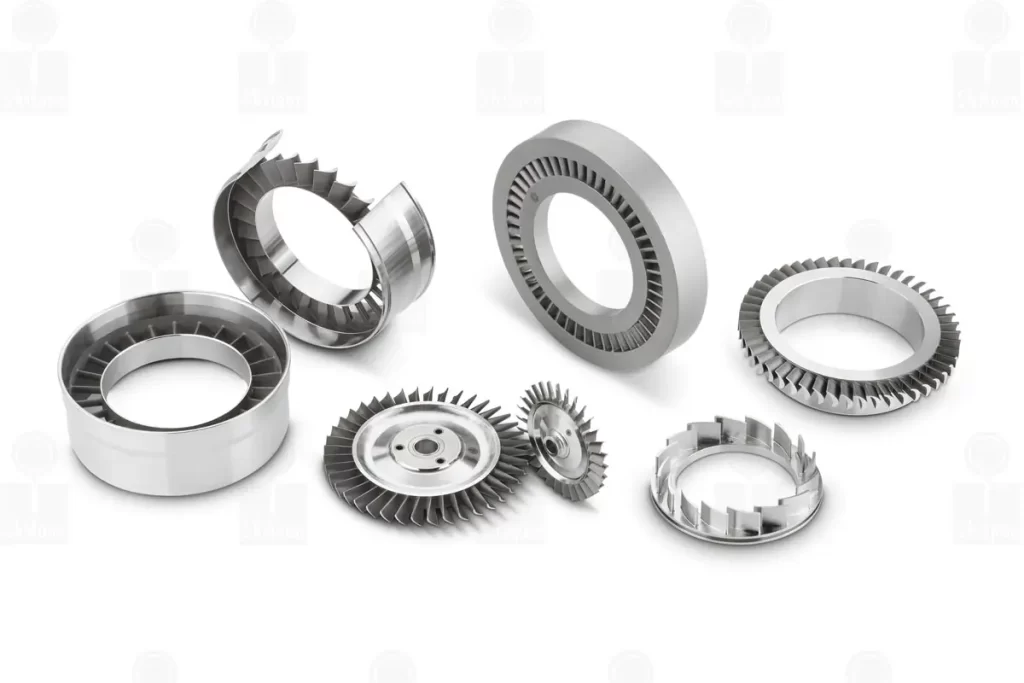
Near-net-shape investment casting is particularly useful when component geometry would be expensive or difficult to create through conventional machining alone.
Examples may include:
- curved profiles,
- internal passages,
- thin sections,
- ribs,
- bosses,
- undercuts,
- varying wall thicknesses,
- complex external contours,
- multiple integrated features.
Producing these features from billet or bar stock may require several CNC setups, specialised cutters, long machining cycles, or significant material removal.
Investment casting allows many of these geometries to be established directly through the wax pattern and ceramic mould.
This is one reason the process is often selected not simply for shape complexity, but for the manufacturing efficiency that complexity can create when it is transferred into the casting stage.
Material Utilisation Can Improve Significantly
Machining a complex component from solid stock can generate a substantial amount of scrap material in the form of chips.
For high-value alloys, this can be particularly expensive.
Investment casting starts much closer to the final component geometry.
While the process still involves its own material considerations, including gating and feeding systems, the finished casting can require considerably less material removal during subsequent machining.
This can improve overall material utilisation.
The advantage becomes more significant when working with:
- stainless steels,
- alloy steels,
- corrosion-resistant materials,
- heat-resistant alloys,
- or other higher-value materials.
Reducing unnecessary material removal can improve both manufacturing efficiency and resource utilisation.
Near-Net Shape Can Reduce Fixture and Setup Complexity
A component requiring extensive machining may need several different setups.
Each setup can introduce:
- additional fixture cost,
- operator handling,
- setup time,
- alignment requirements,
- and another opportunity for dimensional error.
If more of the geometry is created during investment casting, some machining operations may be simplified or eliminated.
For example, instead of machining several external features from raw stock, a casting may already contain those forms.
The machining process can then concentrate on final functional interfaces.
This can reduce the number of times the component needs to be repositioned and make the overall manufacturing sequence more efficient.
Surface Finish Also Influences Downstream Work
Investment casting is known for its ability to produce comparatively good as-cast surface finishes and fine geometric detail.
That does not mean every surface can be used without further finishing.
Functional requirements still determine whether a surface needs machining, polishing, blasting, coating, passivation, or another surface treatment.
However, surfaces that do not perform a critical mating, sealing, bearing, or dimensional function may often remain closer to their as-cast condition.
This allows engineers to distinguish between:
functional surfaces that require secondary finishing
and
non-critical surfaces that can remain as cast.
That distinction can prevent unnecessary machining from being specified simply because it has traditionally been applied to the entire component.
Tolerance Allocation Is Critical
Not every dimension on a component requires the same tolerance.
Over-specifying tight tolerances can increase manufacturing complexity unnecessarily.
When developing an investment cast component, engineers should distinguish between:
- critical functional dimensions,
- assembly interfaces,
- machining references,
- cosmetic dimensions,
- and non-critical geometry.
Critical dimensions may require machining.
Less critical features may be successfully controlled through the casting process.
This tolerance hierarchy allows the manufacturing process to use investment casting where it is most efficient and machining where it is technically necessary.
The result is often a more balanced and economical component design.
Material Behaviour Must Be Considered During Design
Different alloys behave differently during casting, cooling, heat treatment, and machining.
Factors such as:
- thermal contraction,
- solidification behaviour,
- section thickness,
- heat-treatment response,
- distortion tendency,
- and machinability
can influence how close a casting can reliably be produced to final geometry.
For this reason, near-net-shape design cannot be separated from material selection.
A geometry that works well in one alloy may require different allowances or process considerations in another.
Early collaboration between design engineers, casting engineers, metallurgists, and machining teams helps ensure that final dimensions are realistic for both the selected material and manufacturing route.
Near-Net-Shape Design Can Simplify the Entire Manufacturing Chain
The most useful way to evaluate near-net-shape manufacturing is not to examine casting cost and machining cost separately.
The complete manufacturing route should be considered.
A more optimised casting may reduce:
- raw-material requirements,
- machining hours,
- tooling,
- fixtures,
- setup operations,
- handling,
- inspection stages,
- work-in-progress,
- and production lead time.
In some cases, the casting itself may be slightly more complex to engineer or tool.
But if that complexity removes several downstream operations, the overall manufacturing program can become simpler.
This is why component decisions should be evaluated based on total manufacturing effort, not only the cost of an individual process.
Near-Net Shape and Part Consolidation Are Related, but Different
Near-net-shape manufacturing and part consolidation are sometimes discussed together because both use investment casting to reduce manufacturing complexity.
But they address different problems.
Near-net-shape manufacturing focuses on producing one component closer to its final geometry so fewer secondary operations are required.
Part consolidation focuses on combining multiple separate components into a single casting where technically appropriate.
A component can benefit from near-net-shape design even if no parts are being consolidated.
Likewise, a consolidated casting may still require significant machining if its final functional surfaces demand it.
Understanding this distinction helps engineers evaluate each opportunity independently.
When Near-Net-Shape Investment Casting Makes the Most Sense
Near-net-shape investment casting can be particularly valuable when components combine several of the following characteristics:
- complex geometry,
- multiple integrated features,
- expensive material,
- significant machining from solid stock,
- tight requirements on selected functional surfaces,
- moderate to high production volumes,
- repeated CNC setups,
- significant material waste,
- or a need for more consistent long-term production.
It may be less relevant where the component is geometrically simple and can already be manufactured efficiently through another process.
The manufacturing route should always be selected based on the complete technical and economic requirements of the component.
What Engineers Should Evaluate Before Finalising the Design
Before releasing a component for investment casting and machining, engineering teams should review several questions:
- Which dimensions genuinely require machining?
- Which features can be produced in the casting?
- Are machining allowances appropriate for the actual casting variation?
- Have machining datums been considered during casting development?
- Are any tolerances tighter than functionally necessary?
- Can non-critical surfaces remain as cast?
- Are there features that are expensive to machine but straightforward to cast?
- How will heat treatment affect dimensional stability?
- Does the alloy require special machining considerations?
- Can fixture or setup requirements be reduced?
- Is the total manufacturing route being optimised rather than each process independently?
These discussions are most effective before tooling and process development are finalised.
The Advantage of Connecting Investment Casting and Precision Machining
Near-net-shape manufacturing becomes easier to optimise when investment casting and precision machining are considered as parts of the same manufacturing program.
If the casting supplier understands the final machined requirements, the component can be developed with:
- realistic machining stock,
- suitable datum locations,
- controlled critical features,
- appropriate inspection stages,
- and downstream process requirements in mind.
Similarly, machining teams benefit from understanding expected casting variation and how the component was produced.
This coordinated approach reduces the risk of designing a casting that is difficult to machine or creating a machining process that compensates for issues that could have been resolved earlier in casting development.
Near-Net-Shape Manufacturing at Shilpan Steelcast

Shilpan Steelcast combines investment casting with in-house precision machining to support components requiring both complex as-cast geometry and tightly controlled finished dimensions.
By considering casting geometry, machining allowances, datum strategy, inspection requirements, and downstream manufacturing during component development, the manufacturing route can be planned around the final functional requirement rather than treating casting and machining as isolated operations.
Shilpan’s machining capabilities include automated probing and workpiece alignment, helping establish accurate component positioning before machining critical features.
For customers requiring more complete supply, components can also move through inspection, surface treatment, assembly, cleaning, packing, and final preparation within a coordinated manufacturing program.
Designing More of the Final Component Into the Casting
The value of near-net-shape investment casting lies in making the casting perform more of the manufacturing work.
When component geometry, tolerances, machining allowances, materials, datums, and downstream operations are considered together, investment casting can reduce unnecessary material removal and simplify the path from raw material to finished component.
The objective is not to eliminate machining where precision demands it.
It is to ensure that machining is used for the features that truly require it, while investment casting efficiently creates the complex geometry around them.
For engineers and sourcing teams, that can mean lower manufacturing complexity, better material utilisation, fewer secondary operations, and a more efficient route to a finished component.
Discuss Your Component Requirements
If your component requires complex investment casting geometry combined with precision machining, inspection, or ready-to-use delivery, contact Shilpan Steelcast to discuss your drawings, tolerances, material requirements, and opportunities to optimise the complete manufacturing route.
Latest Post
-
 October 30, 2026 Large-Scale Investment Casting Manufacturing in India: What OEMs Should Look For
-
September 29, 2026 Dispatch-Ready Components: Why Cleaning, Packing, and Final Preparation Matter
-
September 28, 2026 Steel Investment Casting in India: Materials, Standards, and Manufacturing Considerations


