



October 30, 2026
Large-Scale Investment Casting Manufacturing in India: What OEMs Should Look For

Investment casting is widely used for producing complex metal components that require dimensional accuracy, intricate geometries, controlled metallurgy, and reliable surface quality. But as component programs grow in volume and complexity, the capabilities required from an investment casting manufacturer change significantly.
A supplier capable of producing a few successful batches may not necessarily be equipped to support a long-running, high-volume program involving multiple part numbers, stringent inspection requirements, downstream machining, assembly, export logistics, and changing production schedules.
For global OEMs and industrial buyers, this makes manufacturing scale an important consideration.
Large-scale investment casting manufacturing is not simply about having a higher annual tonnage capacity. It is about having the infrastructure, engineering depth, process control, quality systems, automation, downstream capabilities, and supply-chain resilience required to support complex component programs consistently over time.
For companies sourcing investment cast components from India, understanding these capabilities can help distinguish between a foundry that can manufacture a component and a manufacturing partner that can reliably support the complete production program.
What Does Large-Scale Investment Casting Manufacturing Really Mean?
Production capacity is usually the first metric associated with manufacturing scale.
It is important, but capacity alone does not provide the complete picture.
A large-scale investment casting operation must be able to manage several interconnected processes, including:
- tooling and wax pattern production,
- wax assembly,
- ceramic shell building,
- dewaxing,
- melting and pouring,
- heat treatment,
- shot blasting and finishing,
- fettling,
- dimensional inspection,
- non-destructive testing where required,
- precision machining,
- surface treatment,
- cleaning,
- assembly,
- packing,
- documentation,
- and final dispatch.
If one of these operations becomes a bottleneck, increasing melting or pouring capacity alone will not necessarily improve overall production capability.
Scale therefore depends on how effectively the complete manufacturing system works together.
Production Capacity Must Be Supported by Process Capability
High-volume programs require more than physical production space.
The foundry must be able to repeat the same manufacturing process consistently across thousands of components and multiple production cycles.
This requires control over variables such as:
- wax pattern accuracy,
- shell-building conditions,
- slurry parameters,
- metal chemistry,
- pouring temperature,
- solidification behaviour,
- heat-treatment cycles,
- dimensional tolerances,
- and finishing requirements.
As volumes increase, small variations can create significant downstream consequences.
A process that appears acceptable during a short production run may become difficult to control when manufacturing continues across multiple shifts, batches, or months.
Large-scale manufacturers therefore tend to place greater emphasis on standardised processes, documented controls, production monitoring, automation, and inspection systems that support repeatability at scale.
Automation Becomes More Important as Production Scales
Automation can play an important role in reducing variation across repetitive manufacturing operations.
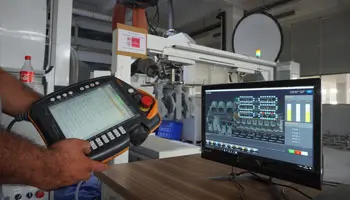
In investment casting, processes such as robotic shelling and robotic pouring can help establish more consistent handling and process execution when production volumes increase.
Robotic shelling can support controlled movement, dipping, coating, and handling of wax assemblies during ceramic mould production.
Robotic pouring can improve consistency in metal handling and pouring sequences while reducing operator exposure to molten metal.
The value of these systems is not simply higher production speed.
Their greater contribution is the ability to execute defined processes repeatedly while reducing unnecessary variation.
Automation is therefore particularly relevant for large-scale investment casting programs where consistency must be maintained across extended production periods.
Capacity for Multiple Programs and Part Numbers
Large OEM programs rarely involve only one component.
A manufacturer may be required to manage:
- several casting designs,
- different alloys,
- varying production quantities,
- multiple delivery schedules,
- prototype development alongside serial production,
- and periodic engineering revisions.
This creates a different level of production complexity.
A foundry supporting multiple programs simultaneously must have sufficient equipment, process capacity, skilled teams, engineering resources, and production planning systems to prevent one program from disrupting another.
This is one of the less visible advantages of manufacturing scale.
The question for buyers should therefore not simply be:
“What is your annual casting capacity?”
It should also be:
“How much production complexity can your manufacturing system manage reliably?”
Engineering Resources Matter as Much as Production Equipment
Complex investment castings often require engineering involvement before production begins.
Component geometry, wall thickness, tolerances, alloy selection, gating strategy, machining allowances, surface requirements, and inspection criteria can all influence manufacturability.
Large-scale manufacturers typically need dedicated engineering teams capable of supporting:
- design for manufacturability,
- tooling development,
- casting simulation,
- gating and feeding design,
- process development,
- trial production,
- root-cause analysis,
- dimensional improvement,
- and continuous process optimisation.
This becomes especially important when a casting moves from prototype development into serial production.
A component that can technically be cast is not necessarily ready for efficient high-volume manufacturing.
The production process must be stable, repeatable, measurable, and capable of meeting long-term quality expectations.
Material Capability Can Influence Program Flexibility
Investment casting is used with a wide range of ferrous and non-ferrous alloys.
For OEMs sourcing multiple component families, working with a manufacturer capable of handling a broad material range can simplify vendor management and improve program flexibility.
Depending on the application, components may require:
- carbon steels,
- low-alloy steels,
- stainless steels,
- heat-resistant alloys,
- corrosion-resistant grades,
- or other specialised materials.
Supporting a wide range of alloys requires more than melting capability.
Manufacturers must control chemical composition, melting practice, heat treatment, material traceability, inspection requirements, and applicable global standards.
A broader material capability allows customers to consolidate more components within one qualified manufacturing system rather than managing several specialised foundries.
Quality Infrastructure Must Scale with Production
As production volumes increase, quality control becomes more demanding.
A larger number of components means a larger amount of production data, inspection activity, documentation, traceability, and quality reporting.
Large-scale programs may require combinations of:
- dimensional inspection,
- chemical analysis,
- mechanical testing,
- hardness testing,
- metallurgical examination,
- surface inspection,
- radiographic testing,
- dye penetrant testing,
- magnetic particle inspection,
- pressure or leakage testing,
- and customer-specific validation.
The ability to perform or coordinate these activities consistently is an important part of production readiness.
A manufacturer may have sufficient casting capacity but still struggle to support a demanding OEM program if inspection and quality systems do not scale with production.
For buyers, this makes quality infrastructure just as important as foundry capacity.
Precision Machining Changes the Value of a Casting Supplier

Many investment cast components are not delivered in their as-cast condition.
Critical features may require CNC machining to achieve final tolerances, sealing surfaces, threads, bores, mounting features, or interface dimensions.
When casting and machining are managed separately, additional variables enter the supply chain.
These may include:
- additional logistics,
- multiple quality systems,
- separate production schedules,
- responsibility gaps,
- datum inconsistencies,
- machining allowances that were not optimised during casting development,
- and longer overall lead times.
A large-scale investment casting manufacturer with integrated precision machining capabilities can manage the component more holistically.
Casting engineers can consider downstream machining requirements during development, while machining teams receive components manufactured within the same coordinated production system.
This can be particularly valuable for complex components where casting geometry and final machined dimensions are closely related.
Assembly Capability Can Extend the Manufacturing Scope Further
Some OEMs require more than individual cast or machined parts.
Components may need to be:
- assembled with sourced parts,
- fitted with fasteners,
- cleaned,
- tested,
- inspected,
- labelled,
- packed,
- and prepared for direct use in the customer’s production environment.
In these situations, the manufacturing requirement extends beyond casting.
A supplier capable of coordinating casting, machining, sourcing, inspection, and final assembly can reduce the number of individual vendors involved in the program.
This does not mean every component needs to be supplied as an assembly.
But having this capability gives buyers more flexibility when programs evolve from individual parts to more complete component packages.
Supply Continuity Becomes Critical for Long-Running Programs
Large-scale manufacturing programs often run for years.
During that time, customers may experience:
- changes in demand,
- production ramp-ups,
- urgent requirements,
- engineering revisions,
- logistics disruptions,
- raw-material fluctuations,
- or changes in sourcing strategy.
A manufacturing partner must therefore be able to support more than the initial production requirement.
Buyers should evaluate whether the manufacturer has:
- reserve production capability,
- multiple production resources,
- maintenance systems,
- alternate equipment capacity,
- qualified technical teams,
- raw-material planning,
- documented process controls,
- and contingency planning.
Manufacturing scale can provide greater flexibility when programs change, but only if capacity is supported by disciplined production planning.
Global Supply Requires More Than Manufacturing Capacity
For overseas customers, the manufacturing process does not end at final inspection.
Components must also move reliably through packing, documentation, logistics, and delivery.
Large-scale exporters must be capable of managing:
- export documentation,
- customer-specific packing,
- corrosion protection,
- component identification,
- traceability,
- container planning,
- shipment consolidation,
- delivery schedules,
- and communication across international supply chains.
For buyers sourcing investment castings from India, export experience can be particularly important.
A technically capable foundry that lacks dependable logistics and documentation systems can still create disruption further down the supply chain.
Certifications and Quality Systems Support Manufacturing Discipline
Large OEM programs frequently require suppliers to operate under recognised management systems and industry-specific quality requirements.
Depending on the market and application, buyers may look for certifications covering:
- quality management,
- environmental management,
- occupational health and safety,
- automotive quality,
- pressure equipment,
- or customer-specific standards.
Certifications alone do not guarantee component quality.
However, they provide evidence that the manufacturer operates within structured systems for documentation, process control, corrective action, traceability, and continuous improvement.
For high-volume or long-running programs, this organisational discipline becomes increasingly important.
Scale Should Create Flexibility, Not Just Volume
One of the biggest misconceptions about large-scale manufacturing is that it only benefits very high-volume programs.
In reality, a well-developed manufacturing infrastructure can support different stages of a component lifecycle.
A customer may begin with:
- prototype quantities,
- engineering trials,
- pre-production batches,
- or low-volume initial supply.
If the program grows, the same manufacturer may then need to support serial production.
This creates an important advantage.
The customer does not have to redevelop the component with a new supplier simply because production volumes increased.
The tooling, process knowledge, material experience, quality history, and manufacturing data already exist within the same system.
For OEMs planning long-term programs, scalability can therefore be just as important as current capacity.
Questions Buyers Should Ask a Large-Scale Investment Casting Manufacturer
When evaluating an investment casting manufacturer in India, production tonnage should be only one part of the discussion.
Buyers should also consider:
- What is the current annual investment casting capacity?
- Which alloys and material standards are supported?
- How is ceramic shell production controlled?
- Are critical processes automated?
- How is melting and pouring controlled?
- What inspection and testing capabilities are available?
- Can the manufacturer support prototype as well as serial production?
- Is precision machining available?
- Can components be supplied fully finished or assembled?
- How are production changes and engineering revisions managed?
- What quality certifications are maintained?
- What export markets are currently supported?
- How is supply continuity managed during demand fluctuations?
- Can the manufacturer support program growth without transferring production elsewhere?
These questions provide a much clearer picture of manufacturing readiness than annual capacity alone.
Large-Scale Investment Casting at Shilpan Steelcast

Shilpan Steelcast operates two manufacturing facilities in Rajkot, Gujarat, with a combined working area of 7,25,000 sq. ft.
With the commissioning of its new investment casting foundry at Unit II, Shilpan has expanded its annual investment casting capacity to 4,800 MT. The new foundry has been developed specifically to support the production of larger investment cast components, strengthening Shilpan’s ability to handle broader component sizes and more demanding large-scale manufacturing requirements.
The expanded foundry includes five robotic shelling machines, while robotic pouring supports controlled metal handling within the investment casting process.
Beyond investment casting, Shilpan integrates precision machining, inspection, treatments, assembly, strategic sourcing, and supply chain management to support customers requiring fully finished and ready-to-use components.
This combination of casting capacity, automation, engineering, downstream manufacturing, quality control, and global supply capability enables Shilpan to support component requirements ranging from development and smaller batches to large-scale production programs.
Scale Matters When Manufacturing Complexity Grows
Selecting an investment casting manufacturer should not be based on production capacity alone.
For complex OEM programs, scale matters because it can provide the infrastructure required to manage variation, production growth, multiple components, downstream processes, inspection, and global delivery within a coordinated manufacturing system.
The real advantage of a large-scale investment casting manufacturer is therefore not simply the ability to produce more castings.
It is the ability to maintain control, consistency, flexibility, and supply confidence as the program grows.
Discuss Your Investment Casting Requirements
If your component program requires scalable investment casting, precision machining, inspection, assembly, or ready-to-use delivery, contact Shilpan Steelcast to discuss your drawings, material specifications, production volumes, and long-term manufacturing requirements.
Latest Post
-
 September 29, 2026 Dispatch-Ready Components: Why Cleaning, Packing, and Final Preparation Matter
-
September 28, 2026 Steel Investment Casting in India: Materials, Standards, and Manufacturing Considerations
-
August 29, 2026 Non-Destructive Testing for Investment Cast Components: A Practical Guide


