


February 28, 2026
Designing Components for Investment Casting: What OEM Engineers Should Know

In many OEM programs, manufacturing challenges are often traced back to decisions made much earlier in the engineering phase. When components are not designed with the manufacturing process in mind, the result can be unnecessary complexity, cost escalation, and production delays.
Investment casting offers engineers remarkable freedom in component design. Intricate geometries, thin walls, complex internal features, and near-net shapes are all achievable. However, realizing these advantages requires an understanding of how the investment casting process interacts with component design.
Engineering for Precision Starts Long Before Production
For OEM engineers working on automotive, fluid systems, industrial equipment, power generation, or modern thermal management systems such as data centre cooling infrastructure, design decisions made at the CAD stage can significantly influence casting quality, manufacturability, and overall system performance.
Understanding how to design effectively for precision investment casting helps engineers unlock the process’s full potential.
Why Investment Casting Enables Complex Engineering Designs
Unlike many traditional metal manufacturing processes, investment casting allows engineers to produce geometries that would otherwise require multiple manufacturing operations.
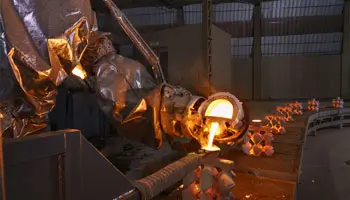
The process involves creating a wax pattern, building a ceramic mold around it, and pouring molten metal into the resulting cavity. Because the mold faithfully replicates the wax pattern, the final component can achieve exceptional dimensional accuracy and surface finish.
For engineers, this translates into several design advantages:
- Complex internal passages
- Reduced need for machining
- Near-net shape production
- Thin-wall sections
- Integrated multi-feature components
These capabilities make investment casting particularly valuable for components where fluid flow, weight optimization, or structural integrity are critical.
Applications include automotive parts, pump housings, valve bodies, impellers, turbine components, manifolds, and, increasingly, liquid-cooling components used in data centre infrastructure.
Key Design Considerations for Investment Casting
While investment casting offers considerable design freedom, certain engineering principles help ensure consistent results and efficient production.
1. Uniform Wall Thickness
Maintaining relatively uniform wall thickness helps ensure proper metal flow and solidification during casting.
Large variations in wall thickness can create casting defects such as localized shrinkage, porosity, or distortion during cooling. Carefully designing transitions between thick and thin sections improves casting stability and structural reliability.
For many investment cast components, wall thicknesses as thin as 0.8 mm can be achieved depending on alloy and geometry.
2. Smooth Geometry Transitions
Sharp corners and abrupt geometry transitions may introduce stress concentrations and casting defects.
Designing smooth fillets and radii improves metal flow within the mold and reduces the likelihood of cracking or internal defects.
In flow-critical components such as pump housings or cooling manifolds, smooth internal transitions also improve fluid dynamics performance.
3. Draft Considerations
Although investment casting requires far less draft than sand casting, some geometry may still benefit from slight draft angles to assist pattern removal and mold integrity.
Engineering teams that consider these details early can avoid later design modifications.
4. Minimizing Secondary Operations
One of the biggest advantages of investment casting is the ability to reduce machining.
Designing parts that take advantage of near-net-shape capability can significantly reduce production costs and shorten lead times.
However, critical surfaces, sealing interfaces, or tolerance-sensitive areas may still require precision machining operations after casting.
Balancing casting accuracy with CNC machining allowances is a key design decision.
5. Alloy Selection and Application Requirements
Material selection influences both casting behavior and final component performance.
Common materials used in precision investment casting include:
- Austenitic stainless steels
- Carbon steels
- Duplex stainless steels
- Nickel-based alloys
- Copper alloys
- Aluminum alloys
For example, data centre cooling components often require corrosion resistance and dimensional stability, making stainless steels a preferred choice.
Engineering teams should evaluate mechanical properties, corrosion resistance, temperature requirements, and compatibility with system fluids when selecting alloys.
Designing for Flow-Critical Applications
Many investment cast components are used in fluid handling systems, where internal geometry directly affects performance.
Examples include:
- Pump bodies
- Valve housings
- Flow manifolds
- Cooling system components
- Turbine housings
In these applications, precision casting offers significant advantages:
- Smooth internal surfaces
- Optimized flow paths
- Reduced pressure loss
- Integration of multiple channels into a single component
This is particularly relevant for liquid cooling systems used in high-performance data centres, where thermal management efficiency is critical to system reliability.
Well-designed cast components can improve cooling efficiency while reducing assembly complexity.
Collaboration Between Engineering and Manufacturing

Successful investment casting projects typically involve early collaboration between OEM engineering teams and casting manufacturers.
When casting specialists are involved during the design phase, they can provide valuable input on:
- Manufacturability
- gating and feeding strategy
- dimensional stability
- material behavior
- cost optimization
This collaboration allows engineers to refine designs while maintaining functional requirements.
Rather than adapting the design after manufacturing challenges arise, the process becomes proactive.
Scaling from Prototype to Production
Investment casting is well-suited for both prototype development and full production programs.
Engineering teams often begin with small batches to validate component performance before scaling to higher production volumes.
Designs that follow good casting principles typically transition smoothly from prototype to production, reducing program risk and manufacturing delays.
This scalability is particularly important for OEMs developing new equipment platforms or emerging technologies, where design refinement continues during early production stages.
Conclusion
Designing components for investment casting requires a balance between engineering creativity and manufacturing practicality.
When OEM engineers understand the capabilities of precision investment casting, they gain access to a process that supports complex geometries, optimized flow paths, and near-net shape manufacturing.
From pump and valve components to emerging applications such as data centre cooling infrastructure, investment casting continues to play a critical role in modern engineering systems.
By integrating manufacturing insight into the design phase, OEM teams can achieve better performance, improved manufacturability, and more reliable production outcomes.
If you are evaluating complex components for investment casting, the engineering team at Shilpan Steelcast can help assess design feasibility and optimize components for reliable production. Contact us today!
Latest Post
-
 February 27, 2026 Why Flow-Critical Components Demand Precision Investment Casting
 -
January 31, 2026 Investment Casting for Data Centre Cooling Systems: Engineering Reliability at Scale
-
January 30, 2026 The Hidden Cost of Vendor Fragmentation and How Integrated Manufacturing Solves It