


February 27, 2026
Why Flow-Critical Components Demand Precision Investment Casting

Fluid systems are among the most unforgiving environments in industrial engineering. Whether the application involves pumps, valves, energy infrastructure, or high-density data centre cooling systems, the components controlling fluid movement must operate with precision and reliability over long service cycles.
In these systems, even minor dimensional variation can disrupt flow balance, introduce pressure losses, or create leakage risks. As operating conditions grow more demanding, with higher pressures, tighter tolerances, and more complex geometries, the choice of manufacturing process becomes critical.
For many flow-critical components, precision investment casting (lost-wax casting) provides the geometric control, surface integrity, and material flexibility required to ensure stable performance.
Why Flow Systems Are Especially Sensitive to Manufacturing Variation
Unlike purely structural components, flow-control parts such as pumps and valves directly influence how fluids move through a system. Internal geometry, surface smoothness, and dimensional consistency all affect performance.
A slight deviation in a valve body or manifold channel can alter turbulence patterns. Small inconsistencies in sealing surfaces can introduce leakage. Even variations in wall thickness can influence thermal behaviour or long-term structural stability.
Because of this sensitivity, fluid systems demand manufacturing methods that deliver both dimensional accuracy and repeatable geometry across production volumes.
Investment casting is particularly well suited to this requirement because it produces near-net shapes with high precision, enabling complex internal passages and flow paths to be formed reliably prior to final machining.
Where Flow-Critical Cast Components Are Used
Many industries rely on precision cast components to maintain stable fluid movement.
Pumps and Valve Systems
Pump housings, impellers, valve bodies, and flow-control assemblies frequently incorporate complex geometries that must withstand pressure while maintaining precise sealing surfaces.
Investment casting allows these components to be produced with intricate internal passages, reducing the need for multi-piece fabrication and minimizing potential leakage points.
For pump and valve manufacturers, this combination of geometric freedom and dimensional stability is essential for maintaining predictable flow characteristics.
Energy and Industrial Fluid Infrastructure
Power generation, chemical processing, and industrial fluid handling systems all depend on components that operate under demanding conditions.
Cast components used in these environments must withstand temperature variations, exposure to corrosion, and continuous mechanical stress. Precision investment casting supports the use of specialized alloys while maintaining tight dimensional control, making it suitable for components that must remain stable over long operating lifetimes.
Data Centre Cooling Systems
As data centres shift toward liquid cooling architectures, fluid reliability has become increasingly important in digital infrastructure.
Cooling systems designed for high-density computing environments rely on manifolds, coolant distribution units, and valve assemblies to circulate coolant through server racks and heat exchangers. These components must maintain leak-free operation while supporting consistent flow across multiple channels.
Precision investment casting can be used to produce manifold bodies, valve housings, and other flow-control hardware for Data Centre Cooling Systems, where geometry consolidation and surface integrity contribute to reliable coolant circulation.
In such applications, repeatability becomes especially important as cooling systems scale across large server installations.
Why Investment Casting Is Well Suited for Flow-Critical Hardware
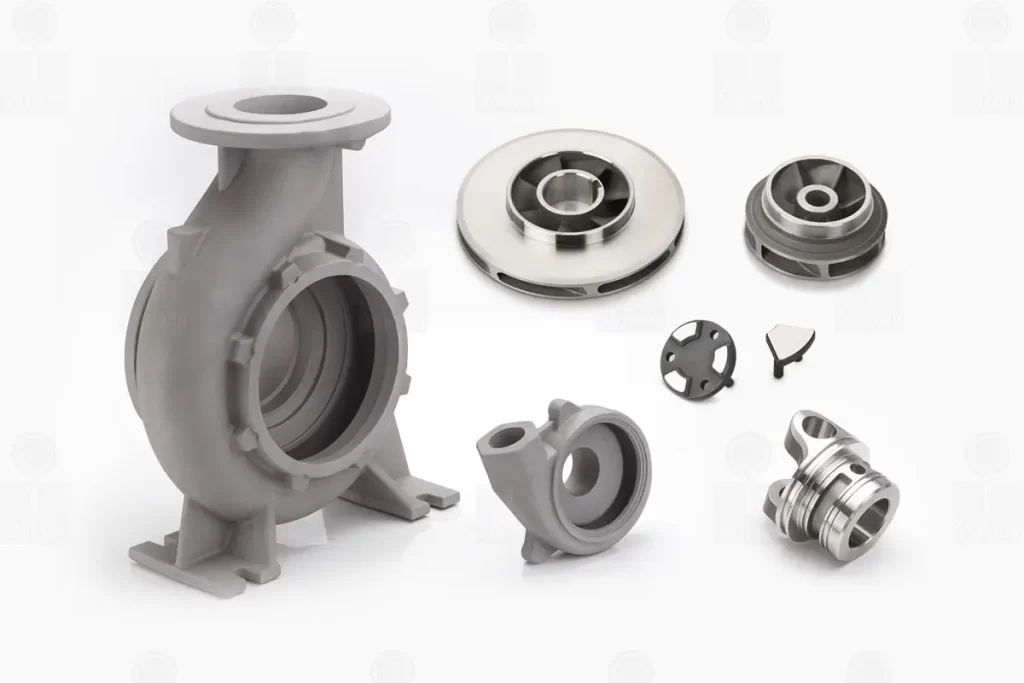
Several characteristics of the investment casting process make it particularly valuable for fluid-system components.
Complex Internal Geometry
Flow-control components often require curved channels, intersecting passages, and integrated mounting features. Investment casting enables these geometries to be produced as near-net shapes, reducing the need for welded assemblies or multiple fabricated parts.
Fewer joints and interfaces typically translate into lower leakage risk and improved structural integrity.
Surface Integrity and Flow Efficiency
Smooth internal surfaces contribute to more stable flow conditions and reduced pressure losses. Investment casting provides a high-quality as-cast surface finish that can be further refined through precision machining, where necessary.
This balance between casting precision and machining accuracy helps maintain reliable flow performance.
Material Flexibility
Fluid systems frequently operate in environments where corrosion resistance and thermal stability are essential. Investment casting supports a wide range of ferrous and non-ferrous alloys, enabling engineers to select materials suited to their operating conditions.
Combined with precision machining, this flexibility allows manufacturers to deliver components that meet both mechanical and chemical requirements.
Maintaining Stability as Systems Scale
As fluid systems grow larger and more complex, consistency becomes increasingly important. A component that performs well in a prototype may behave differently when produced across hundreds or thousands of units.
Precision investment casting supports scalability by enabling consistent part geometry and repeatable manufacturing processes. When casting is integrated with downstream machining and inspection, manufacturers can maintain the dimensional control required for flow-critical components across production volumes.
Conclusion
Flow-critical components demand more than mechanical strength; they require predictable geometry, stable sealing surfaces, and reliable internal flow paths.
Investment casting provides a manufacturing foundation capable of delivering these characteristics. By enabling complex geometries, supporting corrosion-resistant alloys, and maintaining dimensional consistency, the process plays an important role in producing components used in pumps, valves, industrial fluid systems, and emerging technologies such as liquid-cooled data centres.
For OEMs designing fluid-handling systems where performance and reliability are inseparable, selecting the right manufacturing process can be as important as the component design itself.
If your application involves flow-critical components such as pump housings, valve bodies, or cooling system manifolds, aligning casting design with machining and inspection early can significantly improve system reliability.
Contact us today to learn more about Shilpan Steelcast’s expertise in precision investment casting and integrated manufacturing for high-performance fluid system components.
Latest Post
-
 February 28, 2026 Designing Components for Investment Casting: What OEM Engineers Should Know
 -
January 31, 2026 Investment Casting for Data Centre Cooling Systems: Engineering Reliability at Scale
-
January 30, 2026 The Hidden Cost of Vendor Fragmentation and How Integrated Manufacturing Solves It


