


March 26, 2026
How Engineering & Process Control Improves Repeatability in Investment Casting Programs

In investment casting, producing a successful component once is not enough. OEM programs need the same component to be produced consistently across batches, production cycles, and long-term supply schedules.
That is where repeatability becomes critical.
A casting may meet dimensional, metallurgical, and visual requirements in a trial batch, but the real test begins when the same result must be repeated at scale. For OEMs, repeatability affects everything downstream: machining accuracy, assembly fit, inspection stability, lead-time reliability, and field performance.
This is why repeatability in investment casting is not achieved solely through final inspection. It is built through engineering discipline and process control at every stage of manufacturing.
From wax pattern production to shell building, melting, heat treatment, machining feedback, and documentation, every step influences whether an investment casting program remains stable over time.
Why Repeatability Matters in OEM Manufacturing
OEM programs operate within defined schedules, quality requirements, and performance expectations. Components are rarely evaluated in isolation. They are part of larger systems, assemblies, and production flows.
When casting repeatability is weak, the impact can appear in several ways:
- Dimensional variation between batches
- Increased machining corrections
- Higher rejection rates
- Longer inspection cycles
- Assembly fitment issues
- Unpredictable lead times
- More engineering change discussions
- Reduced confidence in future production
For OEMs, these issues create cost beyond the part itself. They affect planning, inventory, line readiness, supplier evaluation, and customer commitments.
A reliable investment casting partner must therefore do more than produce acceptable parts. The supplier must control the process well enough to produce acceptable parts repeatedly.
Repeatability Begins with Engineering Review
Before production begins, the component design must be reviewed through a manufacturing lens.
Investment casting, or lost-wax casting, enables complex geometries, thin walls, integrated features, and near-net-shape production. However, each design must be evaluated for manufacturability, metal flow, shrinkage behavior, machining allowance, heat treatment response, and inspection requirements.
A strong engineering review examines questions such as:
- Are wall thicknesses suitable for stable casting?
- Are transitions smooth enough to support metal flow?
- Are critical surfaces clearly identified?
- Which features will be machined after casting?
- Is there sufficient machining allowance?
- Are datum references practical for inspection and CNC machining?
- Does the selected alloy suit the application and casting process?
- Can the part be produced consistently at the required volume?
This early review reduces uncertainty before tooling, trial production, and full-scale manufacturing begin.
In many cases, repeatability problems are not caused solely by production. They begin when design, casting, machining, and inspection requirements are not aligned early enough.
Wax Pattern Accuracy Sets the Foundation
The investment casting process begins with the wax pattern. Since the ceramic mold is built around this pattern, any inconsistency at the wax stage can carry through to the final casting.
Wax pattern accuracy affects:
- Component dimensions
- Surface quality
- Assembly consistency
- Shrinkage predictability
- Tooling repeatability
- Final machining stock
Controlled wax injection parameters, tooling condition, temperature control, and pattern inspection all contribute to consistency.
For complex OEM components, wax pattern control becomes especially important because small deviations can affect downstream machining and assembly. A pattern that varies slightly from batch to batch may still produce a usable casting, but it may not support stable production over time.
Repeatability starts here because the wax pattern is the first physical expression of the engineered component.
Shell Building and Mold Consistency
After wax patterns are produced and assembled, ceramic shells are built through repeated coating and drying stages. The quality and consistency of this shell directly influence casting accuracy and surface finish.
Shell building must control:
- Slurry consistency
- Coating thickness
- Drying conditions
- Shell strength
- Permeability
- Thermal stability
- Handling discipline
If shell properties vary, the casting outcome can vary. Dimensional accuracy, surface finish, metal flow, and defect risk may all be affected.
For OEM programs, shell consistency is not just a foundry concern. It determines whether production batches remain stable over time.
Controlled shell-building practices reduce variation before molten metal ever enters the mold.
Melting and Pouring Control
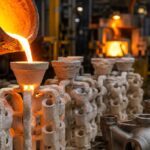
The melting and pouring stage is one of the most critical points in investment casting.
Metal temperature, chemistry, pouring speed, mold temperature, and handling time all influence final casting quality. Poor control at this stage can introduce defects such as porosity, shrinkage, inclusions, misruns, or dimensional inconsistency.
Process control in melting and pouring involves:
- Verified alloy chemistry
- Controlled furnace practices
- Temperature monitoring
- Pouring discipline
- Proper mold preparation
- Clean metal handling
- Defined process parameters
Different alloys respond differently to temperature and solidification conditions. Stainless steels, carbon steels, alloy steels, duplex grades, nickel-based alloys, and other materials each require process knowledge.
For repeatable investment casting, the foundry must understand not only how to melt and pour metal, but how to do it consistently across production batches.
Heat Treatment and Metallurgical Stability
Many investment cast components require heat treatment to achieve the required mechanical properties, hardness, ductility, corrosion resistance, or dimensional stability.
Heat treatment must be carefully controlled because it can influence both performance and geometry.
The process may affect:
- Hardness
- Tensile strength
- Microstructure
- Stress relief
- Distortion behavior
- Machinability
- Final dimensional stability
For components that will later undergo precision machining, heat treatment sequencing becomes especially important. If dimensional movement occurs after machining, final tolerances may be affected. If heat treatment is completed before machining, the manufacturing team must account for the material condition during CNC operations.
A controlled approach to heat treatment helps ensure that metallurgical performance does not come at the cost of dimensional repeatability.
Quality Inspection Is Not a Final Step Alone
Quality Inspection is often viewed as the final gate before dispatch. In repeatable manufacturing, inspection plays a much broader role.
It confirms quality, but it also generates feedback.
Dimensional inspection, visual inspection, material testing, hardness testing, surface checks, and non-destructive testing can reveal patterns in the process. If the same variation appears repeatedly, the issue may point to tooling wear, wax pattern variation, shell inconsistency, heat treatment movement, or machining alignment.
This feedback allows the manufacturing team to correct the process instead of simply sorting good parts from bad ones.
For OEM programs, this distinction matters. Sorting defects may solve an immediate shipment problem. Process correction improves long-term reliability.
Machining Feedback Strengthens Casting Control
In many programs, investment castings do not remain as-cast. They move into CNC machining, finishing, assembly, or supply chain preparation.
This downstream activity provides valuable insight into casting repeatability.
Machining teams can identify issues such as:
- Uneven machining stock
- Datum instability
- Localized distortion
- Inconsistent wall thickness
- Excessive tool load
- Feature misalignment
- Batch-to-batch variation
When machining feedback is connected back to foundry operations, the entire process improves. Tooling adjustments, allowance changes, fixture refinements, or casting process corrections can be made before variation becomes a recurring production issue.
This is why integrated manufacturers have an advantage. When casting and machining operate within one coordinated system, feedback moves faster and accountability is clearer.
Documentation and Traceability

Repeatability depends on discipline, and discipline depends on documentation.
For OEM programs, especially those serving global markets, documentation helps ensure that the same process is followed consistently over time. It also supports audits, certifications, corrective actions, and customer confidence.
Important documentation may include:
- Process parameters
- Material certifications
- Heat treatment records
- Inspection reports
- Dimensional data
- Non-conformance records
- Corrective actions
- Batch traceability
- Customer-specific requirements
Traceability becomes especially important when components are used in critical equipment, fluid systems, energy applications, industrial machinery, or export programs.
Strong documentation does not replace process control. It proves that process control exists.
Repeatability During Scale-Up
Prototype production and serial production behave differently.
A small batch may be manageable through close manual attention. Higher-volume production requires systems, controls, trained teams, equipment capacity, inspection planning, and repeatable workflows.
Many OEM programs face problems during scale-up because a component that was successfully developed in small quantities becomes harder to stabilize in regular production.
Scale-up requires attention to:
- Tooling life
- Wax pattern consistency
- Shell room capacity
- Melting schedules
- Heat treatment capacity
- Machining throughput
- Inspection bottlenecks
- Packaging and dispatch planning
- Supplier communication
A mature investment casting manufacturer plans for these factors before production pressure increases.
Repeatability at scale is not accidental. It is designed into the manufacturing system.
Reducing Risk in Long-Term OEM Programs
OEM buyers and engineering teams are not only concerned with today’s batch. They need confidence that the supplier can support future demand, design changes, documentation needs, and delivery expectations.
This requires more than equipment and capacity. It requires process discipline.
When engineering and process control are strong, OEMs benefit from:
- More predictable component quality
- Lower batch-to-batch variation
- Faster root-cause analysis
- Better machining stability
- Improved assembly readiness
- Stronger documentation
- More dependable lead times
- Reduced supplier-management burden
In long-term programs, these factors influence supplier confidence as much as price or production capacity. A supplier that can explain, control, measure, and improve its process becomes a stronger partner for OEM manufacturing.
Strong process control also plays a direct role in reducing risk in complex OEM programs, especially when casting, machining, inspection, and delivery expectations must remain aligned.
Shilpan Steelcast’s Process-Driven Manufacturing Approach
Shilpan Steelcast’s manufacturing model is built around controlled execution across investment casting, precision machining, assembly, sourcing, and supply chain management.
As one of the largest investment casting foundries in India, Shilpan supports OEM customers that require not only cast components, but components that are machined, inspected, assembled, documented, and delivered with consistency.
This integrated approach helps connect the critical stages that influence repeatability:
- Engineering review
- Investment casting process control
- Heat treatment planning
- Precision machining feedback
- Inspection and quality assurance
- Assembly readiness
- Supply chain coordination
For OEMs, this creates a more reliable manufacturing path from design intent to a production-ready component.
Instead of treating each process as a separate handoff, Shilpan’s model emphasizes connected execution. That is especially valuable for customers managing complex parts, recurring orders, export schedules, or ready-to-use component programs.
Conclusion
Repeatability in investment casting is not achieved by inspection alone. It is created through engineering review, wax pattern control, shell consistency, melting discipline, heat treatment planning, machining feedback, documentation, and continuous process improvement.
For OEM programs, repeatability is what turns a manufacturing supplier into a reliable production partner.
A single good casting proves capability. Repeatedly producing consistent components proves process maturity.
As OEMs look for manufacturing partners who can support complex programs, global delivery, and ready-to-use components, engineering and process control will remain central to supplier selection.
The strongest investment casting programs are not built on isolated production steps. They are built on controlled systems where every stage supports the next.
Build Repeatability into Your Investment Casting Program
If your OEM program requires consistent investment-cast components across recurring production cycles, Shilpan Steelcast can support engineering review, process planning, precision machining, inspection, and supply chain execution within a single coordinated manufacturing system.
Explore Shilpan Steelcast’s integrated capabilities in investment casting, precision machining, assembly, and supply chain management. Contact us today!
Latest Post
-
 September 3, 2026 Non-Destructive Testing for Investment Cast Components: A Practical Guide
 -
August 28, 2026 Gating and Feeding in Investment Casting: Why Metal Flow Determines Casting Quality
-
July 31, 2026 Strategic Sourcing in Ready-to-Use Component Programs: Why Control Matters Beyond the Casting